Parametric Curves
CalcpadCE plots parametric curves directly from their \(x(t)\), \(y(t)\) definitions: pick a parameter range, hand the two functions to $Plot, and the worksheet renders the trace inline.
This group walks through six classic families. The common spirals page surveys Archimedean, logarithmic, hyperbolic and Fermat spirals on a single canvas, while the Cornu spiral (Euler spiral) page traces the clothoid used in highway and railway transitions. The cycloidal pair — epicycloid and hypocycloid — generates the curves swept by a point on a circle rolling around or inside another, with rational ratios producing closed figures. Lissajous curves overlay two perpendicular harmonic motions to recreate oscilloscope patterns, and rose curves draw the petalled trace \(r = a\, \cos(k\theta)\) that fills the polar plane.
Each worksheet exposes the shape parameters at the top, so changing one number redraws the curve immediately.
Common Spirals
Side-by-side plots of the Archimedean, logarithmic, hyperbolic and Fermat spirals on the same canvas, parameterised in polar form \(r(\theta)\).
#hide
#rad
r(θ) = 1
#show
'General parametric equation:
x(θ) = r(θ)*cos(θ)
y(θ) = r(θ)*sin(θ)
'The radius <i>r</i>(<i>θ</i>) if different for each type of curve:
'Archimedes spiral - 'r(θ) = θ
#hide
PlotWidth = 400
PlotHeight = 390
#post
$Plot{x(θ)|y(θ) @ θ = 0 : 8*π}
#show
'Fermat spiral - 'r(θ) = sqr(θ)
#hide
PlotHeight = 387
#post
$Plot{x(θ)|y(θ) & -x(θ)|-y(θ) @ θ = 0 : 8*π}
#show
'Logarithmic spiral -'r(θ) = e^(a*θ)
#hide
a = 0.3
φ = (1 + sqr(5))/2
PlotHeight = 259
#post
$Plot{x(θ)|y(θ) @ θ = 0 : 8*π}
#show
'Golden spiral -'r(θ) = φ^(2/π*θ)
#hide
PlotHeight = 255
#post
$Plot{x(θ)|y(θ) @ θ = 0 : 8*π}
#show
'Hyperbolic spiral -'r(θ) = 1/θ
#hide
PlotHeight = 177
#post
$Plot{x(θ)|y(θ) @ θ = π/8 : 8*π}
#show
'Lituus -'r(θ) = 1/sqr(θ)
#hide
PlotHeight = 188
#post
$Plot{x(θ)|y(θ) @ θ = π/16 : 16*π}
#pre

'Tip: Click "<b>Calculate</b>" to see the respective plot.
General parametric equation:
x ( θ ) = r ( θ ) · cos ( θ )
y ( θ ) = r ( θ ) · sin ( θ )
The radius r(θ) if different for each type of curve:
Archimedes spiral - r ( θ ) = θ !!!

Fermat spiral - r ( θ ) = √ θ !!!

Logarithmic spiral - r ( θ ) = ea · θ !!!

Golden spiral - r ( θ ) = φ2π · θ !!!

Hyperbolic spiral - r ( θ ) = 1θ !!!

Lituus - r ( θ ) = 1 √ θ !!!

Tip: Click "Calculate" to see the respective plot.
Cornu Spiral
Plots the Cornu (Euler) spiral from the Fresnel integrals \(C(t)\) and \(S(t)\), the clothoid used as a transition curve in highway and railway alignment.
'(also <strong>Clothoid</strong> or <strong>Euler Spiral</strong>)
#rad
'The equations is defined by the Fresnel integrals:
x(t) = $Integral{cos(s^2) @ s = 0 : t}
y(t) = $Integral{sin(s^2) @ s = 0 : t}
#hide
PlotWidth = 440
PlotHeight = 400
#post
$Plot{x(t)|y(t) @ t = 0 : 2*π}
#pre

'Tip: Click "<b>Calculate</b>" to see the respective plot.
(also Clothoid or Euler Spiral)
The equations is defined by the Fresnel integrals:
x ( t ) = t∫0 cos ( s2 ) ds
y ( t ) = t∫0 sin ( s2 ) ds

Tip: Click "Calculate" to see the respective plot.
Epicycloid
Trace of an epicycloid: the curve swept by a point on a small circle rolling on the outside of a fixed circle, with rational radius ratios producing closed figures.
'<div style="max-width:150mm">
'<img class="side" src="../../Images/math/epicycloid.png" alt="epicycloid.png">
'<p style="max-width:85mm">Epicycloid is a parametric curve that is obtained by rolling a smaller circle (<var>r</var>) around a larger one (<var>R</var>). It shows the trace of a point P, fixed on the circumference of the smaller circle.</p>
'General equation:
x(θ) = (k + 1)*cos(θ) - cos((k + 1)*θ)
y(θ) = (k + 1)*sin(θ) - sin((k + 1)*θ)
'Larger radius: 'R = ? {21}
'Smaller radius: 'r = ? {10}
'Ratio: 'k = R/r
#pre

'Tip: Click "<b>Calculate</b>" to see the respective plot.
#hide
#rad
PlotHeight = 400
PlotWidth = 400
#post
$Plot{x(θ)|y(θ) @ θ = 0 : 2*π*r}
#show
'</div>
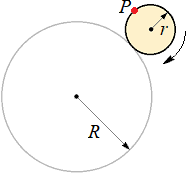
Epicycloid is a parametric curve that is obtained by rolling a smaller circle (r) around a larger one (R). It shows the trace of a point P, fixed on the circumference of the smaller circle.
General equation:
x ( θ ) = ( k + 1 ) · cos ( θ ) − cos ( ( k + 1 ) · θ )
y ( θ ) = ( k + 1 ) · sin ( θ ) − sin ( ( k + 1 ) · θ )
Larger radius: R = 21
Smaller radius: r = 10
Ratio: k = Rr = 2110 = 2.1
Tip: Click "Calculate" to see the respective plot.

Hypocycloid
Trace of a hypocycloid: the curve swept by a point on a small circle rolling inside a fixed circle, including the astroid and deltoid as special cases.
'<div style="max-width:150mm">
'<img class="side" src="../../Images/math/hypocycloid.png" alt="hypocycloid.png">
'<p style="max-width:90mm">Hypocycloid is a parametric curve that is obtained by rolling a smaller circle (<var>r</var>) inside a larger one (<var>R</var>). It shows the trace of a point P, fixed on the circumference of the smaller circle.</p>
'General equation:
x(θ) = (k - 1)*cos(θ) + cos((k - 1)*θ)
y(θ) = (k - 1)*sin(θ) - sin((k - 1)*θ)
'Outer radius: 'R = ? {22}
'Inner radius: 'r = ? {3}
'Ratio: 'k = R/r
#pre

'Tip: Click "<b>Calculate</b>" to see the respective plot.
#hide
#rad
PlotHeight = 400
PlotWidth = 400
#post
$Plot{x(θ)|y(θ) @ θ = 0 : 2*π*r}
#show
'</div>
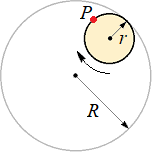
Hypocycloid is a parametric curve that is obtained by rolling a smaller circle (r) inside a larger one (R). It shows the trace of a point P, fixed on the circumference of the smaller circle.
General equation:
x ( θ ) = ( k − 1 ) · cos ( θ ) + cos ( ( k − 1 ) · θ )
y ( θ ) = ( k − 1 ) · sin ( θ ) − sin ( ( k − 1 ) · θ )
Outer radius: R = 22
Inner radius: r = 3
Ratio: k = Rr = 223 = 7.33
Tip: Click "Calculate" to see the respective plot.

Lissajous Curve
Two perpendicular harmonic motions \(x = A\sin(a t + \delta)\), \(y = B\sin(b t)\) overlaid to recreate classic Lissajous oscilloscope figures.
#hide
#rad
PlotHeight = 400
PlotWidth = 400
#show
'Equation:
x(θ) = sin(a*θ)
y(θ) = sin(b*θ)
'Coefficients:'a = ? {2}','b = ? {3}
#pre

'Tip: Click "<b>Calculate</b>" to see the respective plot.
#post
$Plot{x(θ)|y(θ) @ θ = 0 : 2*π}
Equation:
x ( θ ) = sin ( a · θ )
y ( θ ) = sin ( b · θ )
Coefficients: a = 2 , b = 3
Tip: Click "Calculate" to see the respective plot.

Rose Curve
Polar rose curve \(r = a\, \cos(k\theta)\) with petal count controlled by integer or rational \(k\).
'General equation:
r(θ) = cos(a/b*θ)
x(θ) = r(θ)*cos(θ)
y(θ) = r(θ)*sin(θ)
#pre
'<p>Coefficients <i>a</i>/<i>b</i> =
'<select data-target="ab">
'<option value="2;1">2</option>
'<option value="3;1">3</option>
'<option value="4;1">4</option>
'<option value="5;1">5</option>
'<option value="6;1">6</option>
'<option value="7;1">7</option>
'<option value="3;2">3/2</option>
'<option value="5;2">5/2</option>
'<option value="7;2">7/2</option>
'<option value="2;3">2/3</option>
'<option value="4;3">4/3</option>
'<option value="5;3">5/3</option>
'<option value="7;3">7/3</option>
'<option value="3;4">3/4</option>
'<option value="5;4">5/4</option>
'<option value="7;4">7/4</option>
'<option value="2;5">2/5</option>
'<option value="3;5">3/5</option>
'<option value="4;5">4/5</option>
'<option value="6;5">6/5</option>
'<option value="7;5">7/5</option>
'<option value="5;6">5/6</option>
'<option value="7;6">7/6</option>
'<option value="2;7">2/7</option>
'<option value="3;7">3/7</option>
'<option value="4;7">4/7</option>
'<option value="5;7">5/7</option>
'<option value="6;7">6/7</option>
'</select></p>
'<p style="display:none;" id="ab">'a = ? {4}','b = ? {1}'</span></p>

'Tip: Click "<b>Calculate</b>" to see the respective plot.
#hide
#rad
PlotHeight = 400
PlotWidth = 400
k = b*(1 + abs(a⦼2 - b⦼2))
#post
#val
'Coefficients <i>a</i>/<i>b</i> ='a'/'b
$Plot{x(θ)|y(θ) @ θ = 0 : k*π}
General equation:
r ( θ ) = cos(ab · θ)
x ( θ ) = r ( θ ) · cos ( θ )
y ( θ ) = r ( θ ) · sin ( θ )
Coefficients a/b =
Tip: Click "Calculate" to see the respective plot.
Coefficients a/b =4/1
Spotted an error? Edit these examples.